Read today’s passage
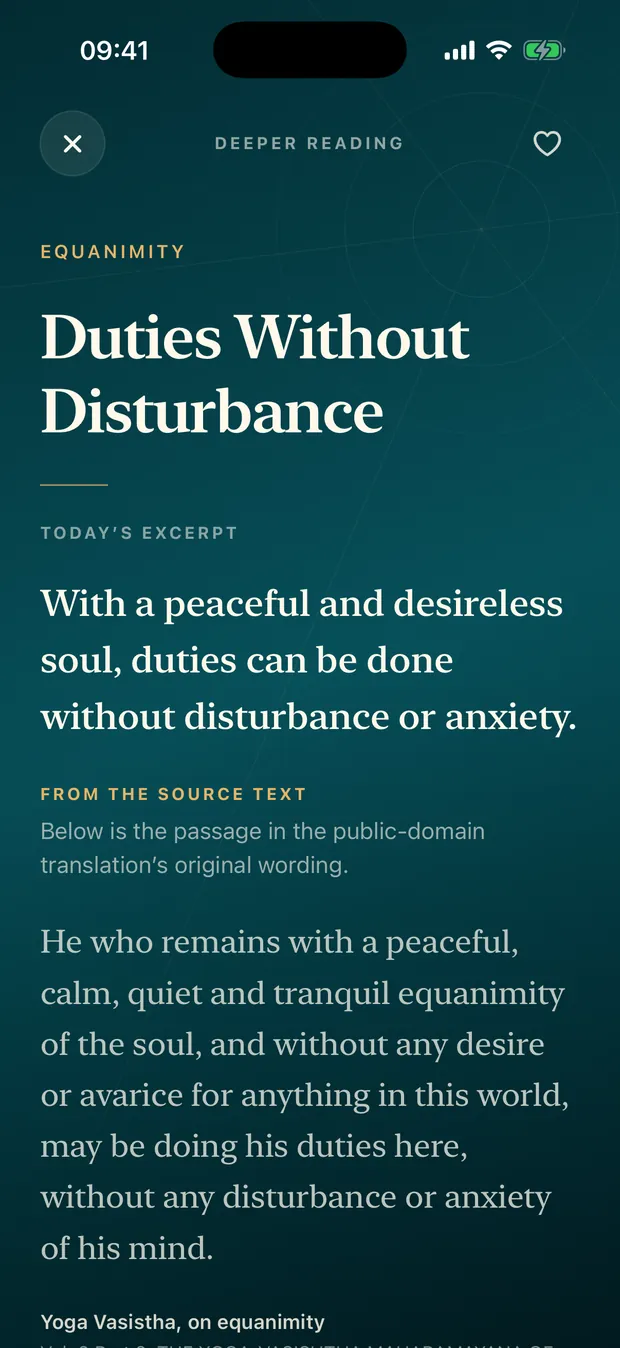
Each day begins with one contemporary editorial rendering from the Yoga Vasistha, shown with its theme, title, and source line. Read it, save it, or keep going into the source. That is the screen at the top of this page.
A daily Yoga Vasistha reader for iPhone and iPad
A Sanskrit dialogue on the mind and the nature of what we call reality. Less a sacred book than an invitation to find out, for yourself, what you are. At thirty thousand verses it is also enormous, so this app gives you one passage a day, in language you can read now, and one question to carry with you.
365 passages · Reading available offline · No account
Available in English for iPhone and iPad.
The text
Less a sacred book than an invitation: to find out, first hand, what you are underneath everything you have been told you are.
Say it roughly as yoga vuh-SISH-tuh. It runs to around thirty thousand verses across six books, is traditionally attributed to Valmiki, and has been dated by scholars anywhere between the sixth century and the fourteenth. Outside India it stays less known than the Bhagavad Gita or the Upanishads, mostly because of its sheer size.
It opens with a crisis anyone can recognize. Prince Rama comes back from a long pilgrimage and stops eating. He has seen how quickly everything passes, and none of what he stands to inherit means anything to him any more. His father calls the court together, and the sage Vasistha is asked to answer him. Everything that follows is the answer.
Vasistha rarely argues in the abstract. He tells stories. Kings live entire lifetimes in the course of an afternoon. A stone is found to hold worlds inside it. Tales open inside other tales until your footing goes. The ground you thought you were standing on is the thing under examination.
It belongs to no religion. There is no rite to perform in it, no god you are required to accept, no lineage to enter. What it offers instead is something you can test: that the world you meet takes the shape of the mind meeting it, and that what you are, underneath the person you take yourself to be, was never in any danger. You are asked to check this against your own experience and against nothing else.
You need no background to begin. A single passage stands on its own.
Nothing to join, nobody to obey. It has been read for centuries by people inside every tradition and outside all of them, because what it points at does not belong to any of them.
vicāraWhere other texts point to fate or grace, this one insists that effort is the thing genuinely available to you, and that what you meet is largely what you have practiced.
puruṣārthaThe arguments arrive as narrative, which is why it has been read for pleasure as often as for study, and why one passage can stay with you for weeks.
upākhyānaReaders have always taken it a few pages at a time and come back to it over years. It is demanding, and it repays the return. That is the whole reason this app exists.
abhyāsaOn Goodreads, readers describe it as something to brace against in a hard year, and as a book that keeps changing as they change. Few finish it quickly. Many never quite finish it at all, and return anyway.
Six books, the last one in two parts. You can read in that order, or ignore it and follow a theme instead.
Thirty thousand verses is a difficult place to begin. Vasistha selects 365 passages and keeps every one of them attached to where it came from: the source reference, the wording of the translation it was drawn from, and the surrounding section you can open and keep reading.
A quotation found online has nothing around it. Here you can always see what came just before it, and what comes next.
How it works
Each day begins with one contemporary editorial rendering from the Yoga Vasistha, shown with its theme, title, and source line. Read it, save it, or keep going into the source. That is the screen at the top of this page.
Tap Go deeper and the older translation the passage came from opens beneath it, with the chapter it belongs to. You can keep reading outward for as long as the passage holds you.
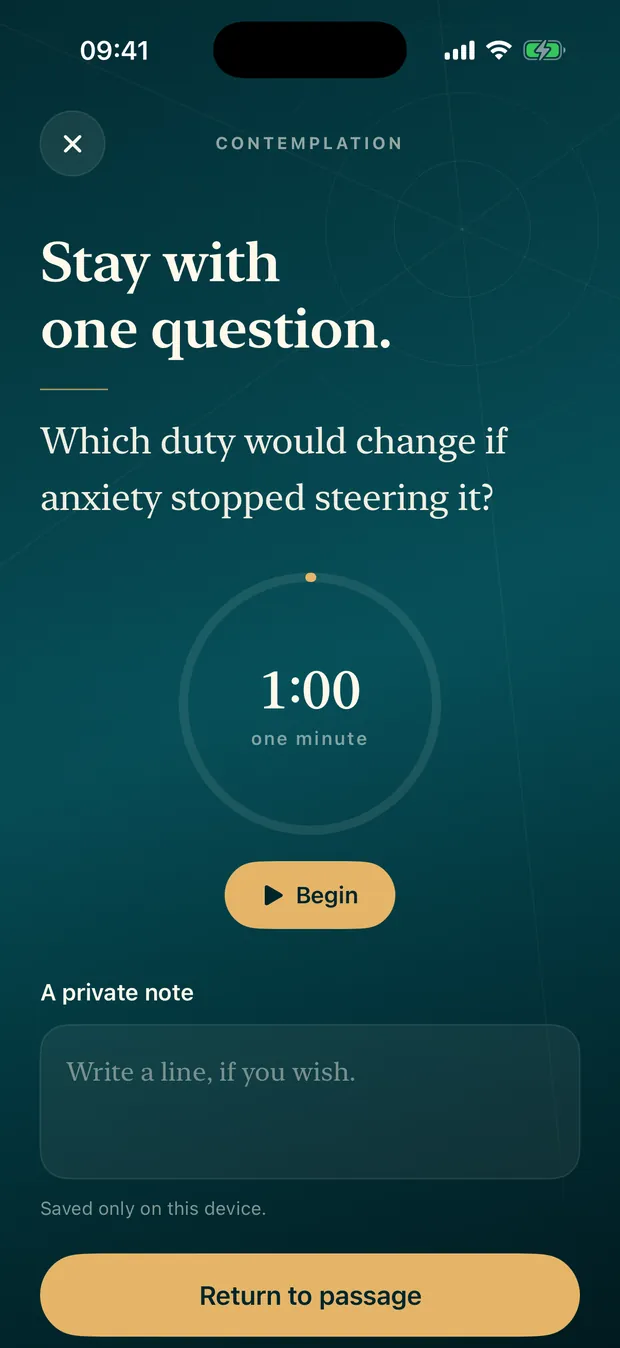
Each passage carries one question. Sit with it for a minute if you like, using the optional timer, and write a note that stays in the app’s local storage on your device.
Going deeper
The daily passage is written in plain contemporary English, so nothing stands between you and the idea. Underneath it sits the older translation the passage was drawn from, with its reference and the section it belongs to.
Stay with the first on a busy morning. Go down into the second when a passage will not let you go.
Today’s excerpt
With a peaceful and desireless soul, duties can be done without disturbance or anxiety.
Written for the app, from the passage beside it
From the source translation
He who remains with a peaceful, calm, quiet and tranquil equanimity of the soul, and without any desire or avarice for anything in this world, may be doing his duties here, without any disturbance or anxiety of his mind.
Vihari-Lala Mitra’s English translation · Yoga Vasistha, on equanimity
Library
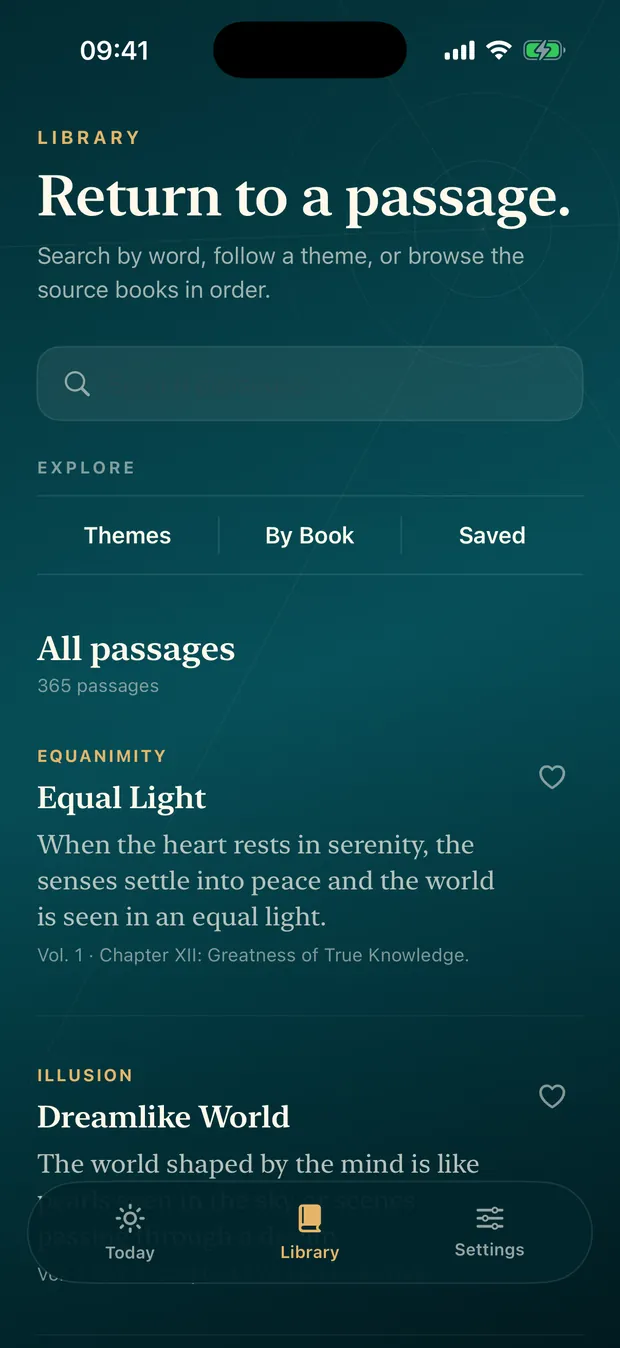
Search by word, explore recurring questions by theme, follow the seven source books and parts in source order, or reopen passages you have saved.
Read across questions of awareness, mind, desire, action, freedom, truth, self-inquiry, and equanimity.
Follow the source structure by book, part, and chapter.
Keep a personal reading list without creating an account. Your saved list is stored locally by the app and is not sent to us.
Daily Bell
Set the Daily Bell for any time, or add the daily passage to your Home Screen or Lock Screen. The bell is scheduled locally through iOS and can be turned off at any time.
Notification content and visibility follow your iOS settings.
Vasistha has no subscription, in-app purchase, or locked reading tier. It contains no advertising, analytics, or tracking. No account is required.
Saved passages, contemplation notes, completion dates, and reminder preferences are stored in local iOS app storage and are not sent to us. Apple-controlled backup or device-transfer features may include app data according to your settings. Vasistha does not operate or access those backups.
No. Most people arrive without having read a word of it, and that is a perfectly good place to begin. Each daily passage stands on its own. When one of them interests you, the source and the text around it are one tap away.
No. Vasistha is a curated collection of 365 passages, not a complete translation or critical edition.
The passages are drawn from Vihari-Lala Mitra’s English translation, which he completed in the 1890s and which is in the public domain, available today through Project Gutenberg. The daily excerpt is a contemporary editorial rendering written for the app, and Mitra’s wording is shown separately beside it, with its source reference. Vasistha is a curated reading companion: not a complete translation, a new translation from the Sanskrit, or a critical edition.
No. Vasistha has no subscription, in-app purchase, or locked reading tier. Any purchase price appears on the App Store before download.
No. The app contains no ads, analytics, or tracking. Your reading activity, saved passages, and contemplation notes are not sent to us.
Yes. The passages and source context are included with the app. Reading, searching, saving passages, and writing notes do not require an account or a connection to a Vasistha server.
No. Vasistha is made for reading and contemplation.
Vasistha is available in English.
A book this size is never finished. It is only entered, on some ordinary morning, at whatever page you happen to open.
Available in English for iPhone and iPad.